NEWS & EVENTS
Research Summary: The history of controlled clinical trials in China
Between May and June 2025, Dr. Xuan YU and Prof. Yaolong CHEN from the Vincent V.C. Woo Chinese Medicine Clinical Research Institute (the Institute), in collaboration with scholars from Harvard University, published a series of four articles in the Journal of the Royal Society of Medicine, the official publication of the Royal Society of Medicine. This series offers a systematic and comprehensive review of the development of clinical trials in China, spanning from the 1940s to the early 21st century. Notably, two of the articles focus on tuberculosis treatment, providing a detailed analysis of the trajectory of controlled clinical trials for tuberculosis in China from the 1940s through the 1990s. These studies furnish a critical historical perspective on the adaptation and contextualization of randomized controlled trials (RCTs) in the Chinese context. This work also fills gaps in research on the history of RCT development in China. Owing to its academic value and methodological contributions, the series has been included in the James Lind Library. This marks the first time that the James Lind Library has featured a series of clinical history studies led by Chinese scholars, signifying a major achievement for China in the field of clinical trial history research.
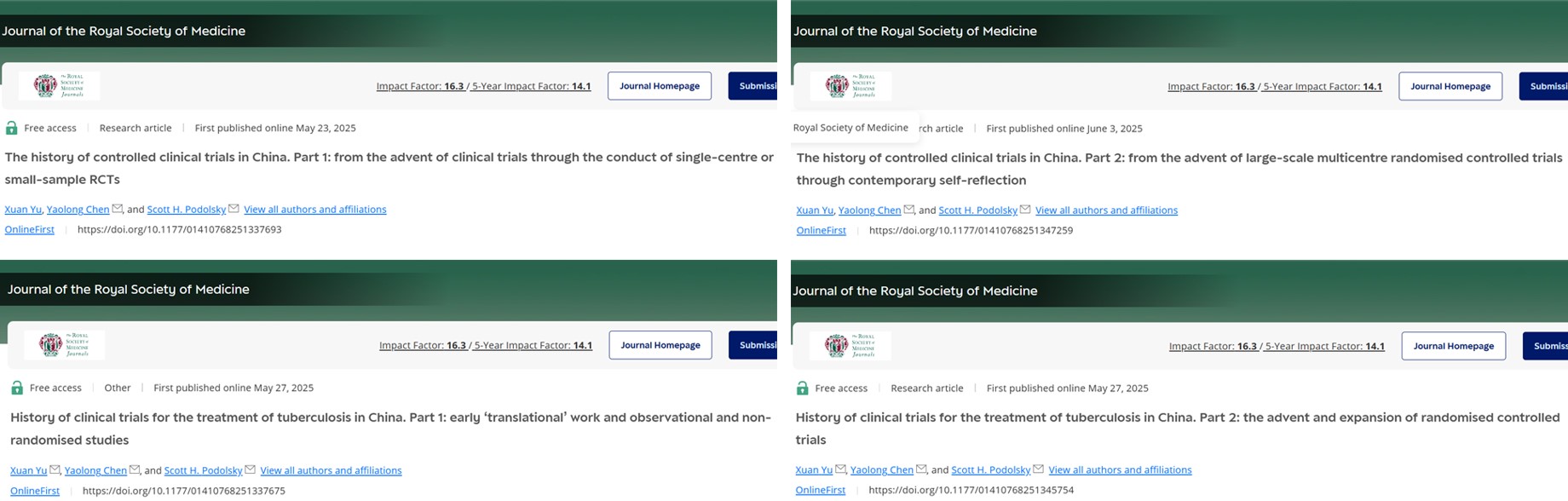
Traditional Chinese Medicine (TCM) has played a crucial role in the historical development of clinical trials in China, and this series systematically examines the evolution of clinical research involving TCM. In the early 20th century, preliminary comparative studies were conducted in Hong Kong to roughly compare the outcomes of plague patients treated with TCM versus those treated with Western medicine. By the late 1950s and early 1960s, controlled trials involving TCM began to emerge gradually in mainland China. The first widely recognized randomized, double-blind controlled trial in TCM was published in 1982 under the leadership of Prof. Keji CHEN (currently a member of the Advisory Board at the Institute), entitled “The Therapeutic Effect of Purified Coronary Heart II Tablets on 112 Cases of Angina Pectoris by Double Blind Method.”
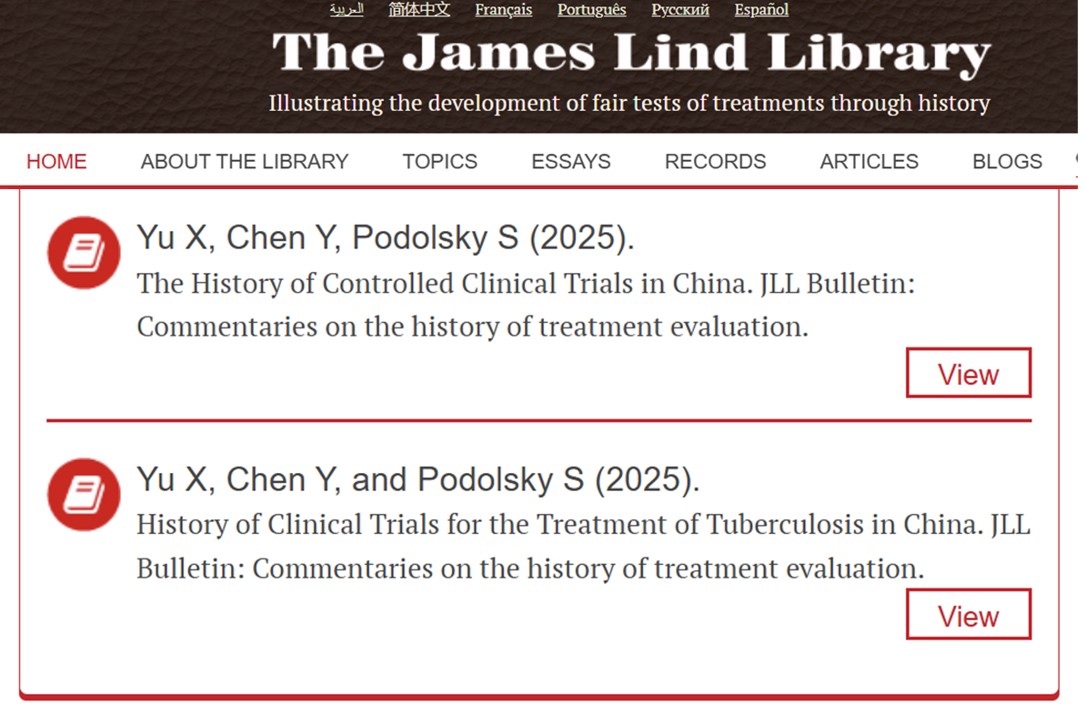
With the increasing implementation and dissemination of controlled trials in TCM, the number of TCM RCTs doubled every two to three years from the early 1980s through the late 1990s, yielding an estimated total of 7500 RCTs by 1996, compared to an estimated 2500 RCTs of “conventional medicine” in China. Meanwhile, growing attention and critique were directed toward the quality of TCM clinical trials. With the advancement of evidence-based medicine and evidence-based TCM in China, efforts to improve the quality and transparency of TCM clinical research have intensified. Notably, reporting guidelines tailored for TCM trials—such as the CONSORT for Chinese Herbal Medicine Formulas, led by Prof. Zhaoxiang BIAN (the Founding Director and Co-Director of the Institute)—have been developed. In addition, the management of clinical trial registration has been strengthened, and an international platform for the registration of traditional medicine clinical trials, the International Traditional Medicine Clinical Trial Registry (ITMCTR), has been established, ensuring standardized and transparent processes from trial registration to publication.
Reviewing, understanding, and analyzing history form the foundation for more effective future planning and development. As a starting point for research on the history of clinical trials in China, this series not only provides evidence for scholars and other interest-holders in the field of TCM to further understand the development of TCM clinical trials, but also offers insights into the future directions of TCM clinical research.
About Dr. Xuan Yu
The first author of this series is Dr. Xuan YU, a Postdoctoral Research Fellow at the Vincent V.C. Woo Chinese Medicine Clinical Research Institute, School of Chinese Medicine, Hong Kong Baptist University. Dr. YU holds a Master’s degree in Global Health from McMaster University in Canada and a PhD with a focus on Evidence-Based Medicine from Lanzhou University. During her PhD studies, she also completed joint research training at Harvard Medical School. Her primary research interests include reporting guidelines, evidence-based science, and evidence-based decision-making.