NEWS & EVENTS
Research Summary: Regulatory frameworks and evidence standards for traditional, complementary and integrative medicines
Hong Kong Baptist University researchers have published a new comparative analysis that maps how different countries regulate traditional, complementary and integrative medicine (TCIM) products, highlighting both shared principles and striking global inconsistencies. A team led by Dr Qi Chen, Prof Zhaoxiang Bian and Prof Kam Wa Chan, with co-authors from Tsinghua University and the School of Chinese Medicine and Vincent V.C. Woo Chinese Medicine Clinical Research Institute at HKBU, examined regulatory pathways for TCIM products in six major jurisdictions – Australia, Canada, China, the Republic of Korea, the United States and the European Union – and compared how these systems define product categories, evaluate evidence and grant market approvals. Traditional and integrative medicine already plays an important role in managing communicable and non‑communicable diseases, and more than 170 WHO Member States formally acknowledge its use through policies, laws or regulations on herbal medicines. Yet there is still no unified global standard for incorporating historical human‑use evidence into regulatory decision‑making, despite WHO’s long‑standing strategy to integrate proven traditional practices into national health systems.
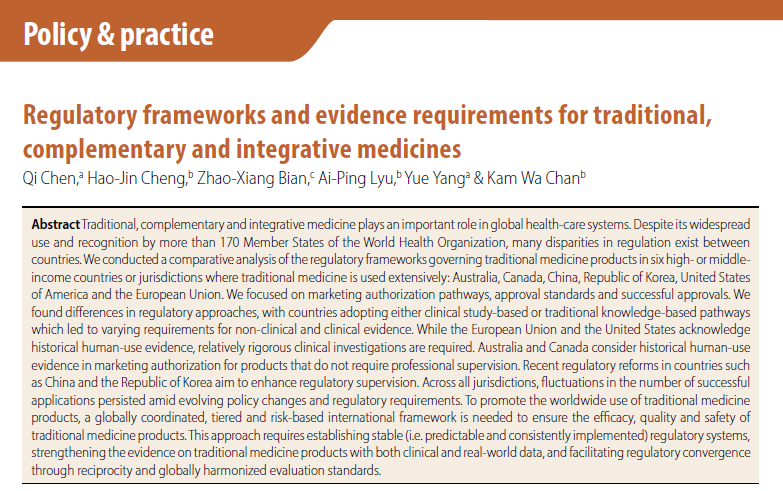
Across the six jurisdictions, three broad regulatory models can be observed. Australia and Canada treat complementary medicines and natural health products as generally lower‑risk categories with simplified or monograph‑based non‑prescription pathways. The European Union and the United States adapt pharmaceutical frameworks with limited simplified routes but typically higher clinical evidence requirements. China and the Republic of Korea apply region‑specific systems rooted in local traditions, combining traditional knowledge and scientific data through multiple pathways. Non‑clinical testing may be partially or fully exempted when there is credible, long‑standing human‑use evidence and the product is considered low risk, but expectations for clinical data vary widely, from acceptance of lower‑level traditional evidence for some non‑prescription products to requirements for randomized controlled trials and systematic reviews comparable to conventional drugs. Large differences in approval volumes are also apparent – with high numbers of monograph‑based or self‑certified products in Australia and Canada, more selective approvals in China, the Republic of Korea, the EU, and the USA. Danshen dripping pills shows how a single product can follow very different regulatory routes and market access conditions in multiple regions.
Fragmented evidence standards, limited mutual recognition and uneven treatment of traditional knowledge emerge as key barriers to global convergence, indicating the need for a coordinated, tiered, risk‑based framework that integrates clinical trial data with robust real‑world and historical evidence, supported by stable regulatory systems, strengthened quality control and more harmonized evaluation criteria.
This research direction aligns with HKBU’s broader work on evidence‑based Chinese medicine and regulatory science and underscores the Institute’s commitment to advancing international standards for safe, effective and scientifically grounded traditional and integrative medicine. The Vincent V.C. Woo Chinese Medicine Clinical Research Institute continues to support the research and development of Chinese medicine globally.