NEWS & EVENTS
Research Summary: Prospective registration of guidelines and consensus statements of traditional and integrative medicine: Current status and experience from the PREPARE platform
Led by Dr Xuan Yu, Prof Zhaoxiang Bian and Prof Yaolong Chen of the Vincent V.C. Woo Chinese Medicine Clinical Research Institute at Hong Kong Baptist University, a multi‑institutional team has published a comprehensive analysis of the prospective registration of traditional and integrative medicine (TIM) clinical practice guidelines and consensus statements. This study focuses on the Practice guideline REgistration for transPAREncy (PREPARE) platform, an open, bilingual registry that accepts guideline projects from around the world.
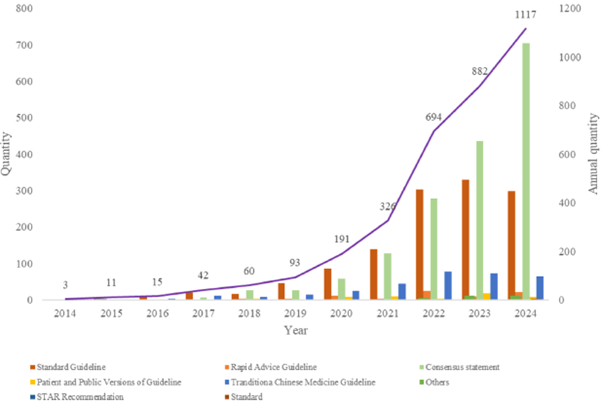
By 31 December 2024, PREPARE had recorded 3,434 guideline and consensus statement projects, of which 587 (17.1%) related specifically to TIM. Among these TIM projects, 64.7% focused on traditional medicine (such as traditional Chinese medicine and acupuncture) and 35.3% on integrative medicine. Since 2022, the number of newly registered TIM guidelines and consensus statements grew rapidly, with annual registrations exceeding 100.
The detailed analysis shows that most TIM-related registrations were standard guidelines (68.3%), with consensus statements making up about a quarter of records. Majority of projects (93.9%) were registered as original versions, and nearly half addressed both diagnosis and treatment, while about one quarter focused solely on treatment. Importantly, 87.1% of registered projects reported that recommendations would be informed by systematic reviews, and 85.3% planned to grade the strength of evidence and recommendations—most commonly using the GRADE system or its modified versions adapted for traditional medicine literature.
Despite these encouraging trends, only 25.2% of TIM guideline and consensus statement registrations had uploaded a protocol at the time of registration, limiting the ability of peers, editors, and clinicians to assess and verify planned methods. While 79.4% of projects reported at least one funding source—most frequently national or governmental funding—information on industry involvement and other potential conflicts of interest was relatively rare. It is also noted that possible regional and language bias because the majority of TIM registrations originated from China and PREPARE currently accepts submissions only in Chinese and English.
The PREPARE working group is already implementing measures to address these challenges. Ongoing initiatives include enhancing the platform’s data fields, forming an international academic advisory board, expanding coordination teams, and actively promoting registration among TIM guideline developers and journal editors. The study recommends that developers routinely register forthcoming guidelines, upload detailed protocols, and promptly update their registration records if the scope or methods change, thereby reducing duplication, improving collaboration, and strengthening trust in TIM guidelines and consensus statements.
By mapping the current landscape of TIM guideline registration, this work complements the Institute’s ongoing research on clinical practice guidelines, evidence grading, and methodological quality in Chinese medicine. It underscores the Institute’s commitment to advancing rigorous, transparent, and internationally recognized guidelines and standards for traditional and integrative medicine practice.
About Dr. Xuan Yu
The first author of this series is Dr. Xuan YU, a Research Assistant Professor at the Vincent V.C. Woo Chinese Medicine Clinical Research Institute, School of Chinese Medicine, Hong Kong Baptist University. Dr. YU holds a Master’s degree in Global Health from McMaster University in Canada and a PhD with a focus on Evidence-Based Medicine from Lanzhou University. During her PhD studies, she also completed joint research training at Harvard Medical School. Her primary research interests include reporting guidelines, evidence-based science, and evidence-based decision-making.